
Become a Kiwa PVEL Premium Partner
Receive more detailed Scorecard data every quarter, sent directly to your inbox.

IAM test results across 72 BOMs continued to show strong alignment to the PVSyst default Fresnel ARC model. While accurate IAM testing can differentiate nuances between BOMs, Kiwa PVEL’s measurements likely contradict the overly optimistic IAM curves provided by some manufacturers.
IAM TESTED BOMS IN 2026 SCORECARD DATASET
MEDIAN IMPACT ON ENERGY YIELD VERSUS DEFAULT
RANGE IN ENERGY YIELD IMPACT
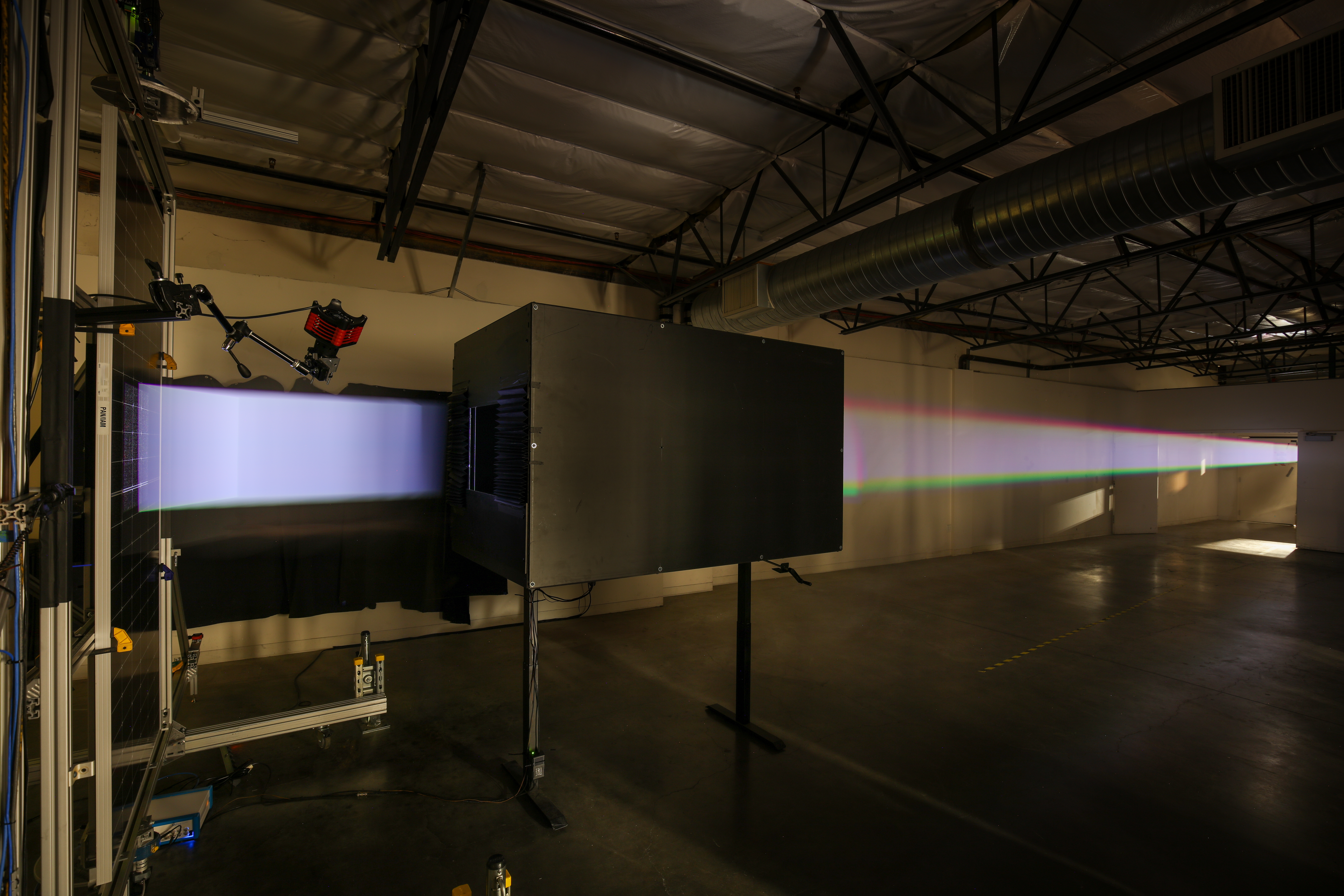
Incident Angle Modifier (IAM) coefficients evaluate the response of a PV module to light coming from various angles. IEC 61853-2:2016 defines an indoor test method for characterization of the IAM values of a PV device with respect to the angle of incidence (AOI) by measuring short-circuit current (Isc). Kiwa PVEL has improved upon this test method to capture IAM profiles for both glass//backsheet and glass//glass modules. This unique indoor IAM testing method has demonstrated world-leading results for precision and repeatability.
Measurements over the past year using Kiwa PVEL’s best-in-class test method1 continued to show that the IAM values for commercial modules are aligned with the PVSyst default Fresnel ARC model. The median increase in energy yield for a single-axis tracker system in Las Vegas, NV, using the measured IAM curve compared to the PVSyst default is only 0.04%.
With the highest accuracy IAM test in the world2, Kiwa PVEL can reliably measure differences in IAM performance between BOMs. The highest performer’s modelled energy yield was 0.57% higher than the lowest performer for a simulated single-axis tracker site in Las Vegas, USA. See the Test Results Spotlight for more on BOM impacts.
While the sample size was lower for HJT, Kiwa PVEL’s IAM measurements indicate that HJT modules on average have a lower IAM energy yield impact than TOPCon and PERC modules. This difference was 0.2% less energy yield for a simulated single-axis tracker site in Las Vegas, USA, and is likely due to the blue light absorption in the amorphous silicon for HJT cells.
BOM differences cause measurable changes in IAM performance. Some manufacturers/BOMs use light redirecting films (LRF) between the cells to direct reflected light toward the cells. In recent years, LRFs have become more popular, with 30% of IAM tested BOMs using LRF in the 2026 Scorecard dataset. While LRFs improve power output (when measured under normal incidence), they cause a slight reduction in IAM performance. The figure below shows a down-selection of TOPCon BOMs tested on a single IAM tester, comparing the performance of modules with and without LRF. Modules with LRF underperform modules without LRF by 0.12% in a simulation of energy yield for a single-axis tracker system deployed in Las Vegas, USA.
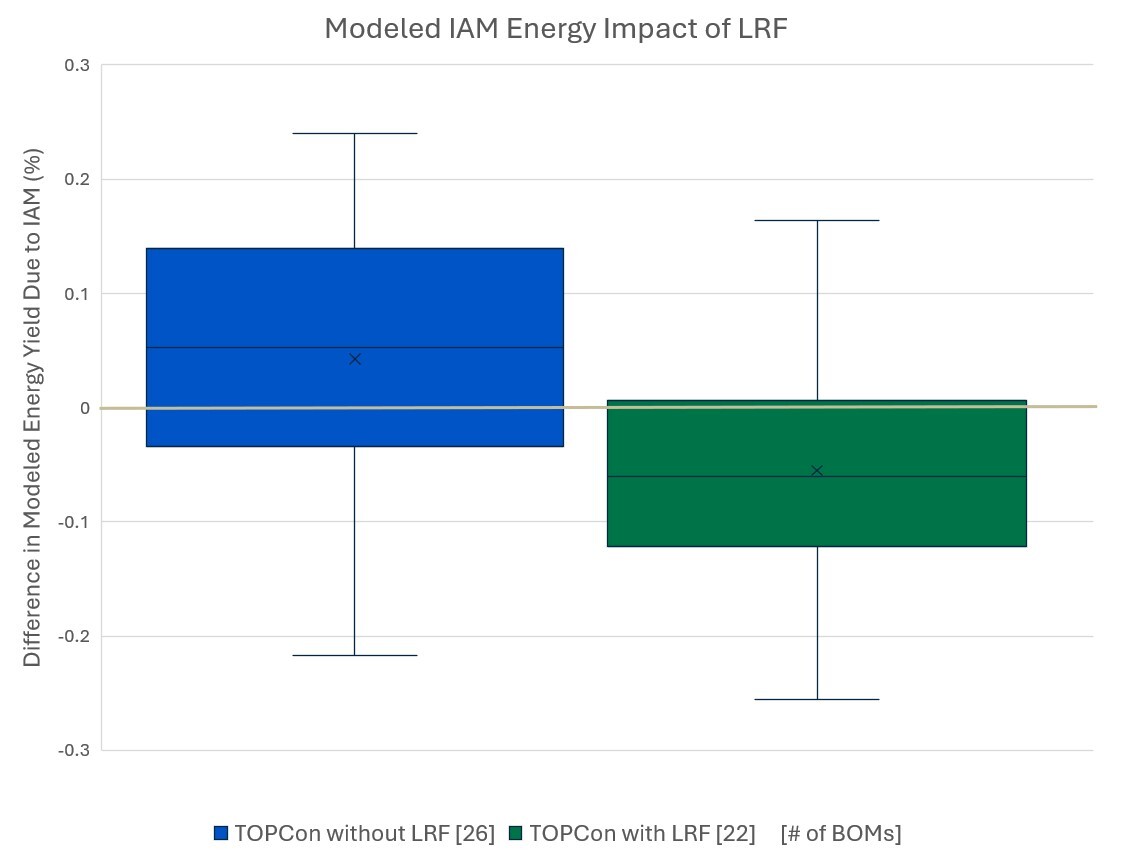
The impacts to modeled energy yield for measured IAM compared to PVsyst Fresnel ARC default (represented as 0.0) for a single-axis tracker site in Las Vegas, USA.
View Box Plot Interpretation Guide
Kiwa PVEL’s IAM measurements on 72 BOMs (with three samples measured per BOM) over the past year continue to show a relatively tight alignment. On average, these measurements align with the PVsyst Fresnel ARC default up to 30 degrees and overperform the PVsyst Fresnel ARC default at 50 degrees and greater.
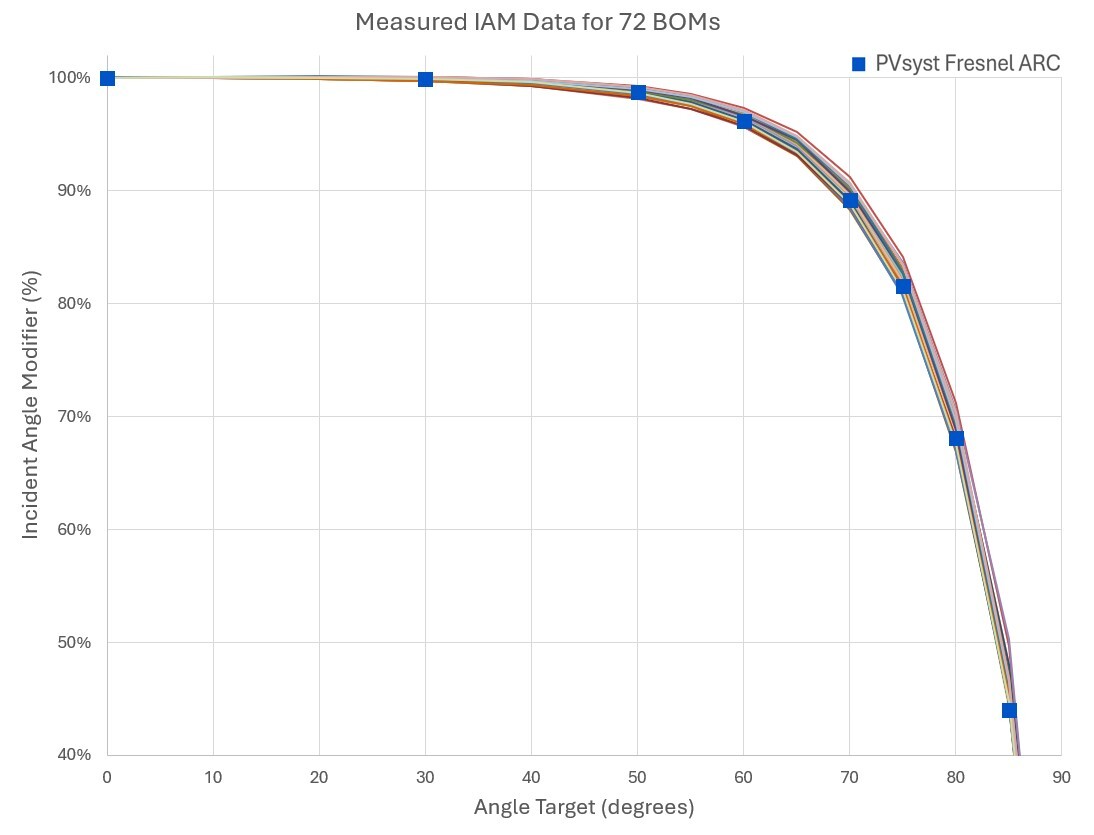
Kiwa PVEL’s IAM test results for 72 BOMs from the 2026 Scorecard dataset show strong consistency. PVsyst’s Fresnel ARC default included for reference.
The PAN and IAM test procedure, what PV module materials are assessed, and a case study on why PAN is important can be found here on kiwa.com/pvel
1. Riedel-Lyngskær N, Santamaría Lancia AA, Plag F, et al. Interlaboratory comparison of angular-dependent photovoltaic device measurements: Results and impact on energy rating. Prog Photovolt Res Appl. 2021; 29: 315–333. https://doi.org/10.1002/pip.3365
2. Kiwa PVEL has < 0.5% total expanded uncertainty up to 60 degrees AOI (angle of incidence). In prior work comparing IAM uncertainty, other labs self-reported total-expanded uncertainty ranges from 1.2% to 2.5% up to 60 degrees AOI.
Receive more detailed Scorecard data every quarter, sent directly to your inbox.
