
Become a Kiwa PVEL Premium Partner
Receive more detailed Scorecard data every quarter, sent directly to your inbox.

Kiwa PVEL observed notable and statistically significant improvements in the UVID results over the past year. However, UVID remains a key module reliability and performance concern, and the current 3.0% median UVID power loss for TOPCon BOMs shows that there is still room for improvement.
BOMs are UVID Top Performers
Manufacturers are UVID Top Performers
of BOMs had a UVID failure
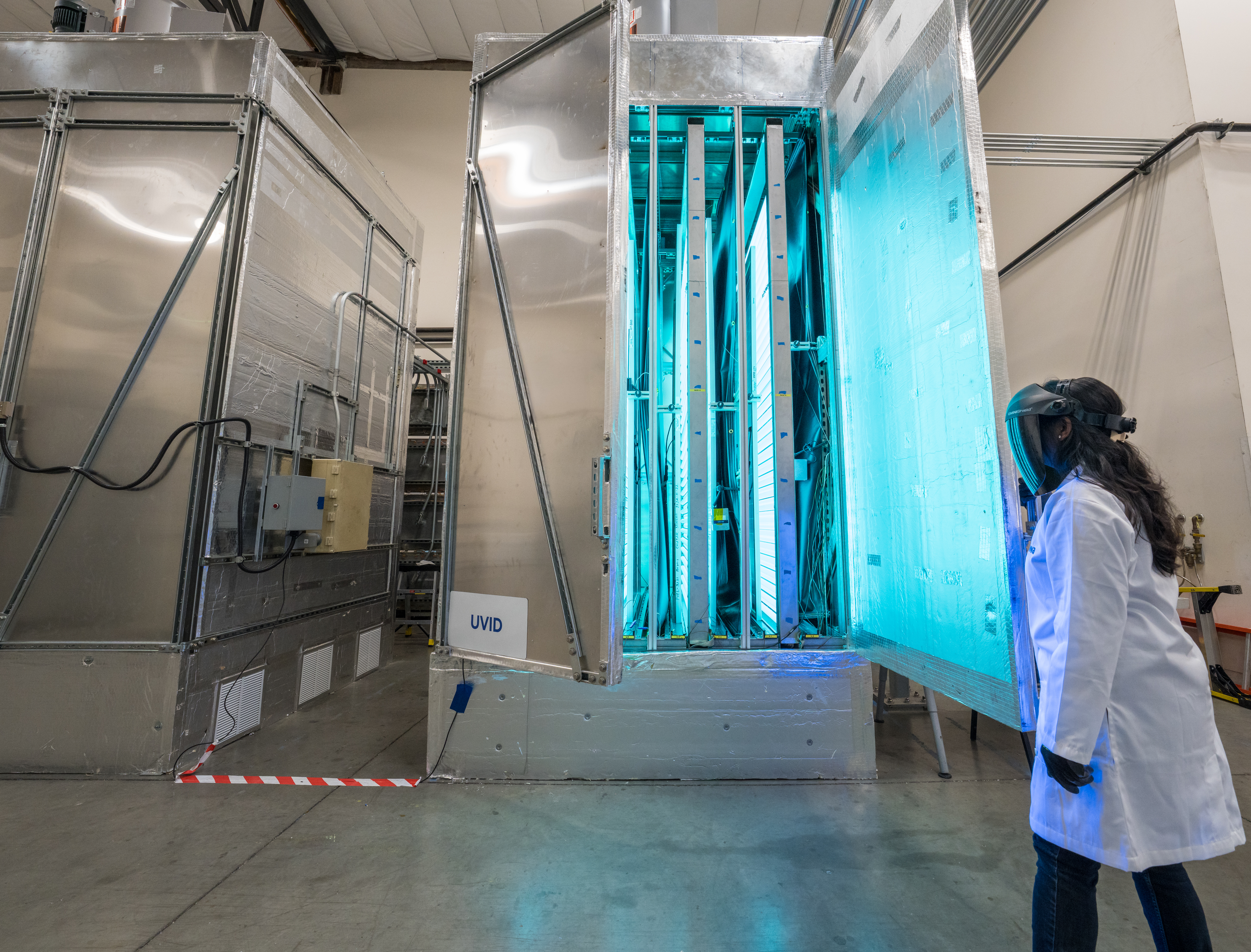
Kiwa PVEL’s Ultraviolet Induced Degradation (UVID) test goes beyond standard IEC/UL certification to identify modules that are susceptible to this degradation mechanism. While the 120 kWh/m2 test duration is not necessarily sufficient to reach the maximum amount of degradation resulting from UVID, this test is able to distinguish between UVID-susceptible and UV-stable modules. Kiwa PVEL has noted a range of UVID results across TOPCon and HJT modules.
UVID test results over the past year indicate improved UVID performance in TOPCon BOMs, with median power loss reduced from 4.2% to 3.0%. This may be attributed to improved process and quality control at cell production facilities; however, UVID remains a challenge for some manufacturers.
As the median UVID power loss has reduced over the past year, so has the percentage of BOMs experiencing a UVID failure, which decreased from 6% in the 2025 Scorecard to 3%. The recent failures were one BOM with delamination following UVID and another BOM with power loss high enough that the manufacturer instigated a UVID retest on new samples.
The PQP’s optional Field Exposure test has identified some BOMs with significant degradation (median: 2%, maximum: 8%) following one year of deployment in Davis, CA. This has been mainly attributed to UVID, since the combined power loss from these BOMs following LID and LETID is less than 1% and the EL images show a distinct checkerboard pattern.
Both TOPCon and HJT modules exhibit dark storage degradation after test completion; however, the effect is more pronounced in UVID-sensitive TOPCon modules, with degradation rates up to 1% power loss per day. A brief exposure to full-spectrum light can partially or fully reverse the metastable degradation, reducing power loss to just the field relevant UVID.
Even cells sourced from the same supplier can have significant differences in UVID susceptibility. In this case, BOM 1 used M10 cells and experienced 14.1% power loss post-UVID120. BOM 2 used G12R cells from the same cell manufacturer and experienced 3.6% power loss post-UVID120. This difference was entirely driven by cell process recipe (mainly cell passivation and anti-reflection stacks), where small changes could have big impacts. For example, a thinner (4nm vs. 7nm) AlOx layer delivers inferior UVID resilience by acting as a less effective barrier to the transport of mobile hydrogen[1]. Sufficient cell production process and quality control is necessary to ensure UVID resistance.
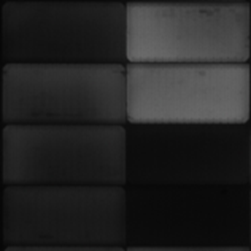
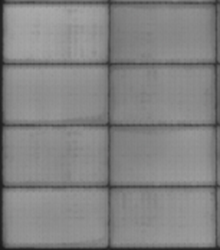
BOM 1 shows an extreme case of post-UVID 'checkerboard' and power loss, while BOM 2 had significantly lower UVID but still exceeded the Top Performer threshold. Click on each image to see the corresponding full-size EL image.
M. U. Khan et al., "Charge Trapping, Hydrogen Accumulation, and Structural Rearrangement: A Complete Model for Ultraviolet-Induced Degradation in TOPCon Devices." Solar Energy Materials and Solar Cells 298 (May 2026): 114149. https://doi.org/10.1016/j.solmat.2025.114149
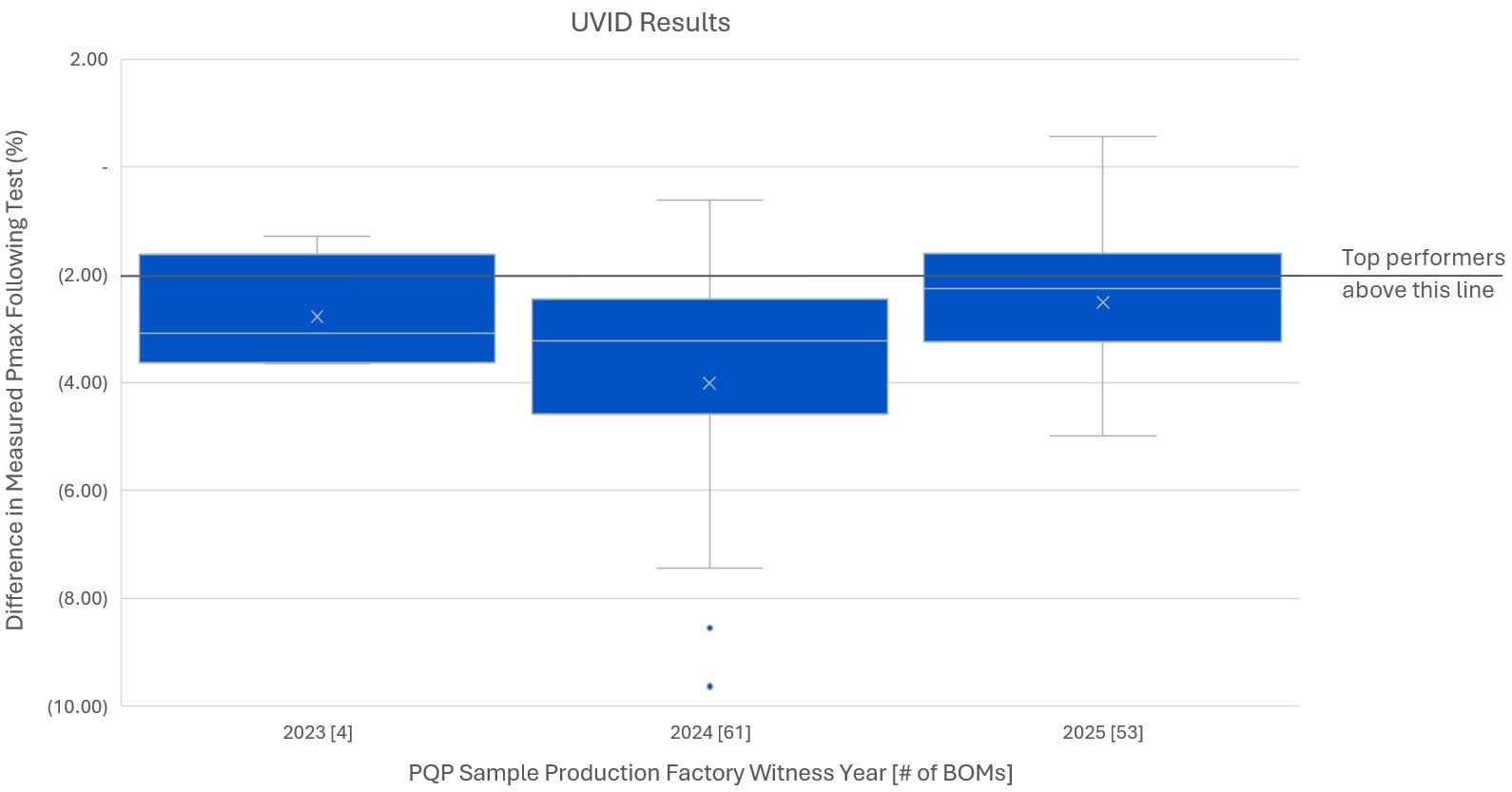
Outliers with >10% degradation are not shown. In some cases, these cause a significant reduction in the mean.
View Box Plot Interpretation Guide
Receive more detailed Scorecard data every quarter, sent directly to your inbox.
